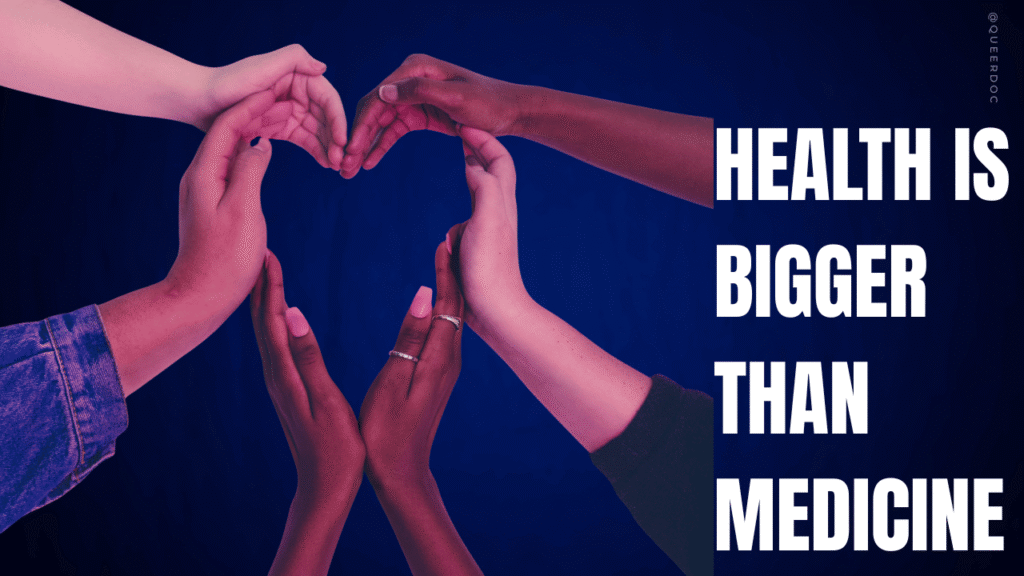
Medicine has an important role in health.
It also has limits.
At QueerDoc, we believe excellent gender affirming care includes practicing excellent medicine and recognizing that medicine as practiced in the US healthcare system is only one way to support healthier and happier humans.
Biomedicine has given us extraordinary tools. Antibiotics, vaccines, surgery, hormone therapy, and preventive care have transformed countless lives.
At the same time, medicine in the United States has also caused tremendous harm. It has been used to pathologize, criminalize, police, exclude, and erase transgender people, queer people, disabled people, people with ovaries/uteri, BIPOC, and many other communities. It has systemically undervalued the wealth of knowledge and ways of healing held in community.
Much of what is now considered gender affirming care exists because communities organized, cared for one another, generated knowledge, and demanded change, not because biomedicine led the way. Transgender people were teaching one another how to navigate hormones, bodies, relationships, and healthcare long before many clinicians received formal education on these topics. Medicine has much to contribute, but it also has much to learn.
The opposite of medicalizing every human experience isn’t abandoning medicine. It’s recognizing that medicine is one part of the many ways in which we can thrive and explore embodiment.
Why do we use “embodiment”? We define embodiment as living more and more in connection with and our physical bodies. It describes the joy and wonder of gender euphoria.
Practicing Medicine with Humility
One of QueerDoc’s core values is practicing medicine through an anti-racist lens.
Part of that work means recognizing that biomedicine is one knowledge system available to us, but it is not the only or most important knowledge system. Across cultures and throughout history, people have learned, healed, and grown through educators, birth workers, artists, coaches, peers, spiritual leaders, elders, and countless other healers whose expertise has often been devalued by systems of healthcare shaped by white supremacy and colonialism.
Recognizing those forms of knowledge doesn’t diminish medicine.
It makes medicine more humble.
And, we believe, more effective.
The Questions that Deserve More than Medicine
Dr. Beal here.
As a family physician, I spend a lot of time talking with transgender and gender diverse people about hormones, surgery, preventive care, and primary care.
I also hear questions that medicine alone was never designed to answer.
Some questions are about our bodies:
- How do I connect with. my changing body?
- How do I build a joyful relationship with movement?
- How do I feel more at home in my body?
- How do I explore sexuality, intimacy, and pleasure?
Some questions are about our relationships:
- How do I communicate my needs to a partner?
- How do I navigate dating?
- How do I build meaningful community?
- How do I cultivate relationships that affirm who I am?
Some questions are about living authentically:
- How do I dress in a way that feels like me?
- How do I advocate for myself when systems weren’t designed with me in mind?
- How do I build confidence?
- How do I create a life that feels sustainable, authentic, and joyful?
These are deeply important questions.
Many physicians receive little or no training in these areas. This is not because the questions don’t matter, but because they fall outside the traditional scope of Western medical education. They draw on lived experience, movement, education, creativity, communication, advocacy, community knowledge, and forms of expertise that medicine has not historically centered.
Finding joyful movement isn’t a prescription.
Developing a personal style isn’t a medical intervention.
Building confidence isn’t a medication.
Learning to communicate with a partner isn’t a diagnosis.
Creating community isn’t something a physician can prescribe.
They’re part of fully living into our personhood.
Those experiences deserve knowledgeable support, too.
Knowing Where Our Expertise Ends
One of the most valuable lessons medicine has taught me is that good care isn’t about having every answer.
It’s about understanding where my expertise begins, where it ends, and who else should be at the table.
QueerDoc’s goal isn’t to become everything for everyone.
Our goal is to become better at recognizing when someone else is the expert.
Sometimes the most affirming thing a physican can do isn’t provide another answer.
Sometimes it’s introducing someone to the right person.
Building a Community of Healers
At QueerDoc, we’re interested in building a model of gender affirming care that recognizes healing as something that happens in relationship: with our communities, with our bodies, and with people whose expertise comes from many different places.
That means continuing to provide excellent medical care while also creating space for educators, coaches, birth workers, advocates, artists, peers, and others whose work supports aspects of life that medicine was never designed to hold alone.
We don’t see these forms of support as alternatives to medicine.
We see them as complimentary.
Because gender care is more than hormones and surgery.
And healing has always been bigger than medicine.
Looking Ahead
Over the coming months, QueerDoc will begin partnering with trusted educators, coaches, advocates, and other collaborators whose expertise complements medical care while remaining grounded in our commitment to evidence informed, patient centered, anti-racist care.
Stay tuned for links to our coaching services to go live.
- Gender Affirming Community Healers and Coaching Services
- Community Healers and Coaching Services Pricing & Booking
- Meet Goddess Briq House